
Lemon Balm for Sleep: How It Helps Calm a Busy Mind Before Bed
- June 22, 2026
- 5 min read

Some nights, the problem is not that your body is not tired.
It is that your mind has not slowed down yet.
You finish the day, get into bed, and still feel mentally active. Messages, plans, screens, unfinished tasks, and tomorrow's to-do list keep running in the background. Your body is ready for sleep, but your brain is still in "on" mode.
That is where lemon balm becomes interesting.
Lemon balm, also known as Melissa officinalis, is a leafy herb from the mint family. Its leaves have a soft lemon-like scent, but in a bedtime formula, its value is not about flavor. Its value is helping the evening move from mental activity into a calmer state before sleep.* Research reviews describe lemon balm as a botanical studied for calmness, psychological well-being, cognition, and sleep-quality support.
Quick Take
- Lemon balm is Melissa officinalis, a leafy herb from the mint family, not lemon flavor or a skin balm.
- Lemon balm is used in bedtime formulas to help calm a busy mind before sleep.*
- Lemon balm has been studied for sleep-quality support, easier settling before bed, and deeper rest patterns.
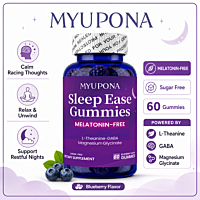
- MYUPONA Sleep Ease Gummies include Lemon Balm Extract (Melissa officinalis) (leaf), 10:1 as part of a melatonin-free bedtime formula.*
What Is Lemon Balm?
Lemon balm is the common name for Melissa officinalis L., a plant in the mint family. The name comes from the soft lemon-like scent of its leaves, not from lemon juice, lemon peel, or citrus flavoring.
That distinction matters.
In sleep products, lemon balm is not there to make the formula taste like lemon. It is there because the leaf contains naturally occurring plant compounds, including rosmarinic acid, citral, oleanolic acid, ursolic acid, flavonoids, and other phytochemicals studied for their relationship with calmness, mood, cognition, and sleep quality. Rosmarinic acid is also commonly used as a quality marker for lemon balm extracts.
In MYUPONA Sleep Ease Gummies, lemon balm appears as:
Lemon Balm Extract (Melissa officinalis) (leaf), 10:1 - 150 mg per serving
That means the formula uses a defined lemon balm leaf extract, not a vague herbal blend.
Lemon Balm Helps Calm a Busy Mind Before Bed
One of lemon balm's strongest bedtime benefits is helping the mind shift out of daytime activity.
This is important because many people do not go to bed peacefully. They go to bed after scrolling, working, answering messages, watching videos, checking tomorrow's schedule, or thinking through things they did not finish. The body may be tired, but the mind is still processing.
Lemon balm is useful here because it supports the calmer side of the nervous system.* Instead of treating sleep like a switch, it helps support the state you want before sleep begins: quieter, less reactive, and less mentally crowded.
That is why lemon balm works so well as a bedtime botanical. It speaks to the real problem many adults feel at night: not a lack of tiredness, but a mind that has not fully powered down.
Lemon Balm Helps You Settle Into Sleep More Easily
Falling asleep is not only about being tired.
You also need to feel settled enough to let sleep happen.
Lemon balm supports that settling process. By helping the evening feel calmer, lemon balm helps support the transition from awake to asleep, making bedtime feel easier and less forced.* This is especially relevant for people who lie in bed tired but mentally alert.
Human research has connected lemon balm extract with improvements in sleep-quality scores. In one clinical trial, daily supplementation with a standardized Melissa officinalis leaf extract was associated with improved Pittsburgh Sleep Quality Index scores after three weeks compared with placebo. The PSQI looks at sleep quality and patterns across domains such as sleep latency, sleep duration, sleep disturbances, and daytime function.
For a consumer, the practical meaning is simple: lemon balm is not just a pleasant-sounding herb. It has a real place in the conversation around easier sleep onset and better nighttime rest.*
Lemon Balm Supports Better Sleep Quality
Good sleep is not only about how many hours you spend in bed.
Sleep quality is about how the night feels as a whole: how easily you settle, how steady the night feels, how often sleep is interrupted, and how restored you feel the next day.
Lemon balm is valuable because its sleep story goes beyond "feeling relaxed." Research has connected Melissa officinalis extract with improvements in subjective sleep quality, which makes it especially relevant for people who want their nights to feel smoother and more complete.
That matters for bedtime formulas.
A strong sleep formula should not only make the user think about getting sleepy. It should help support the full wind-down experience: less mental activity before bed, a smoother path into sleep, and a night that feels more restful.*
Lemon balm helps build that direction.
Lemon Balm Supports Deeper, More Restorative Rest
Lemon balm also supports the quality of rest after sleep begins.
Many people care about this more than they care about "getting sleepy." They want to know whether the night feels restorative. They want to wake up feeling like they actually rested, not just that they spent time in bed.
A 2024 study on a standardized Melissa officinalis phytosome reported improvements in sleep-related scores and observed an increase in time spent in deep sleep, also known as slow-wave sleep. Slow-wave sleep is widely discussed as one of the most restorative stages of sleep and an important part of sleep quality.
That gives lemon balm a stronger bedtime story.
It is not only about relaxing before bed. It also has a place in the deeper-rest conversation - the part of sleep that makes the night feel more complete and restorative.*
How Lemon Balm and Chamomile Complement Each Other
Chamomile is one of the botanicals most people already recognize in bedtime teas and evening wellness products. It has a gentle floral profile and is closely associated with winding down at night.
Lemon balm adds a different kind of bedtime support.
While chamomile brings a soft, traditional nighttime botanical, lemon balm is more connected with the busy-mind side of sleep. It is studied for calmness, sleep-quality support, and its relationship with GABA-related calm-down pathways. That makes lemon balm especially useful when the body feels tired but the mind is still active.
Together, they support the bedtime routine from two angles.
Chamomile helps create a gentle, soothing bedtime direction. Lemon balm helps support the mental calm-down side of the night - the shift from "still thinking" to "ready to rest."*
This is why the two botanicals work well together in a sleep formula. Chamomile helps set the tone for a softer evening routine, while lemon balm adds deeper support for relaxation, easier settling before sleep, and a calmer nighttime rhythm.*
Why MYUPONA Uses Lemon Balm Leaf Extract 10:1
Lemon balm can appear in many forms: tea, dried herb, powder, tincture, capsule, or extract.
For a gummy, extract form makes the most sense.
A gummy has limited space. It cannot carry the same amount of plant material as a tea bag or loose herb blend. A 10:1 extract allows lemon balm to be included in a more concentrated botanical format while keeping the serving simple.
MYUPONA uses Lemon Balm Extract (Melissa officinalis) (leaf), 10:1.
The leaf matters because it is the part associated with lemon balm's recognizable herbal profile and naturally lemon-like aroma. The extract ratio matters because it shows this is a concentrated botanical extract, not plain dried leaf powder.
Each serving of MYUPONA Sleep Ease Gummies includes 150 mg Lemon Balm Extract 10:1, giving the formula a clear botanical sleep-support ingredient inside a simple gummy format.*
The Bottom Line
Lemon balm has a clear place in bedtime support because it speaks to one of the most common sleep challenges: a body that feels tired, but a mind that has not fully slowed down.
As a botanical ingredient, lemon balm helps support relaxation before sleep, a calmer nighttime rhythm, and the transition into more restorative rest.* Its connection with GABA-related calm-down pathways also gives it a stronger role than a simple "herbal" label.
That is why MYUPONA Sleep Ease Gummies include Lemon Balm Extract (Melissa officinalis) (leaf), 10:1 as part of a melatonin-free bedtime formula.
Together with GABA, L-Theanine, Magnesium Glycinate, and Chamomile Extract, it helps support a calmer wind-down before bed - without making melatonin the center of the routine.*
Explore MYUPONA Sleep Ease Gummies
Explore MYUPONA Sleep Ease Gummies for melatonin-free bedtime relaxation support.*
Shop Sleep Ease Gummies*These statements have not been evaluated by the Food and Drug Administration. This product is not intended to diagnose, treat, cure, or prevent any disease.
References
- Mathews IM, Eastwood J, Lamport DJ, Le Cozannet R, Fanca-Berthon P, Williams CM. Clinical Efficacy and Tolerability of Lemon Balm (Melissa officinalis L.) in Psychological Well-Being: A Review. Nutrients. 2024. https://www.mdpi.com/2072-6643/16/20/3545
- Bano A, et al. The possible calming effect of subchronic supplementation of a standardised phospholipid carrier-based Melissa officinalis L. extract in healthy adults with emotional distress and poor sleep conditions. Frontiers in Pharmacology. 2023. https://www.frontiersin.org/journals/pharmacology/articles/10.3389/fphar.2023.1250560/full
- Di Pierro F, et al. Effects of Melissa officinalis Phytosome on Sleep Quality: Results of a Prospective, Double-Blind, Placebo-Controlled, and Cross-Over Study. Nutrients. 2024. https://www.mdpi.com/2072-6643/16/23/4199
Related Products
Recent Posts
-
Everyday Care, Inside and Out
 June 26, 2026
 -
Working Out Before Bed? How to Wind Down After an Evening Workout
 June 25, 2026
 -
Circadian Rhythm and Sleep: How Your Body Clock Shapes Better Rest
 June 24, 2026
 -
Common Questions About Cooling and Warming Massage Balms
 June 24, 2026